

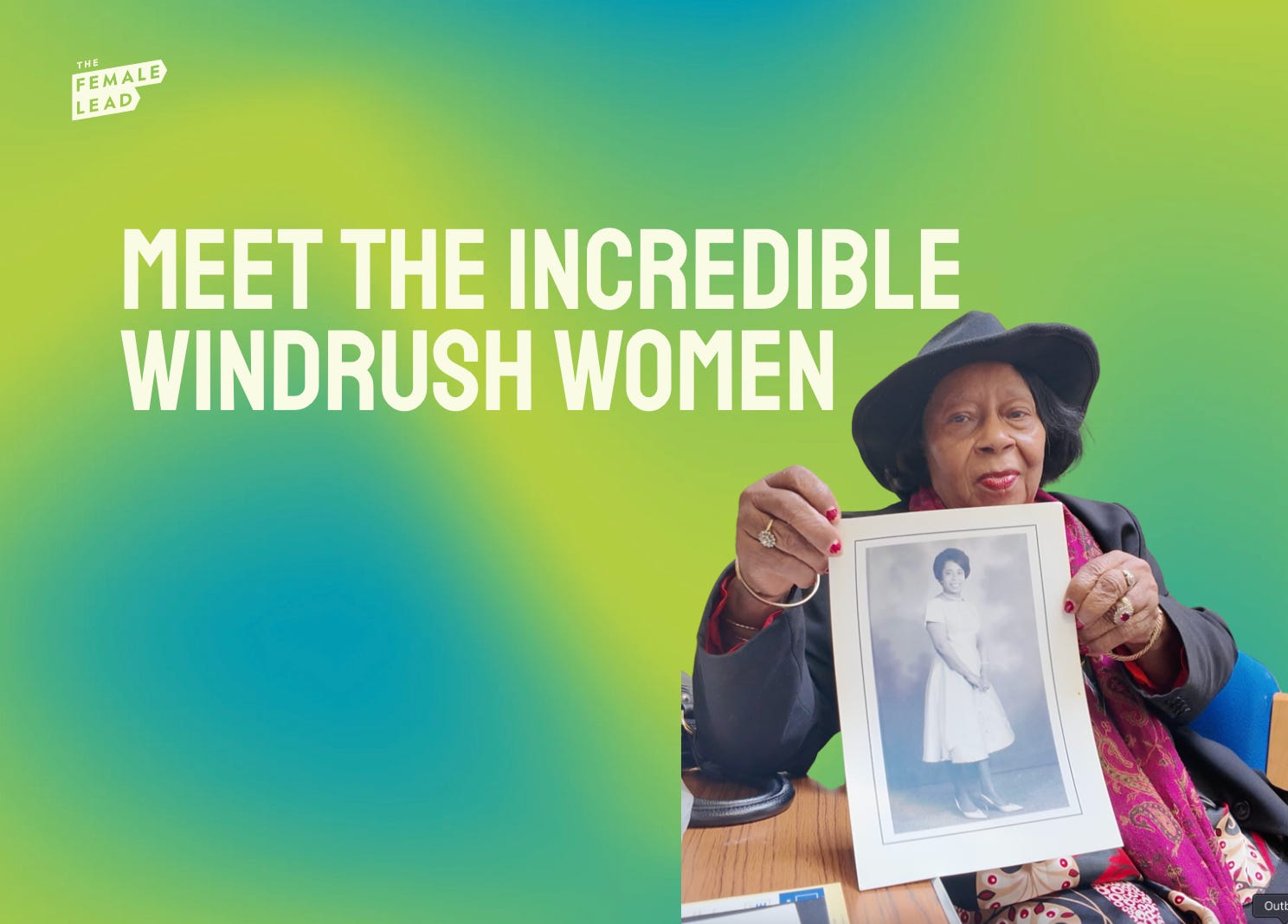
Since 2018, 22 June has been celebrated as Windrush Day in the UK — a chance to honour the arrival of the Empire Windrush in 1948 and recognise the generations of Caribbean people who came to Britain to help rebuild the country after the Second World War. Their contributions have shaped modern Britain, from the NHS and public transport to schools, businesses and communities across the nation.
To mark this year’s Windrush Day, we had the privilege of spending time with six remarkable women at The Positive Network in Balham, South London. Carmen, Beryl, Veronica, Betsy, Zena and Alicia all travelled to Britain from Jamaica or Guyana during the Windrush era, many of them as teenagers or in their early twenties, leaving behind family, familiarity and the lives they had known.
Despite the challenges they faced along the way, every single woman told us the same thing: she never regretted making the journey.
Read the full article below.
Welcome back to Take The Lead, the fortnightly newsletter from The Female Lead.
Here’s a roundup of the articles you loved this month.
This month, we spoke to Emma Barnett about her new documentary on endometriosis and the hidden toll of a condition that affects millions of women yet remains misunderstood, underfunded and too often ignored.
We also looked back at the history of women’s football, from pioneering teams and a decades-long ban to the rise of the Lionesses, celebrating the women who transformed the game and changed its future.
And while progress has often been painfully slow, 2026 has offered signs that women's health is finally being taken more seriously. We explored some of the year's biggest advances so far, from breakthroughs in endometriosis and menopause research to new approaches to chronic pain, heart health and personalised care.
Enjoy this issue, share it if you like it, and reply directly to let us know what you think.
You can also catch up on our most recent full newsletter here.
The Female Lead Team
The extraordinary women of Windrush

Since 2018, every year on 22 June, the UK celebrates Windrush Day, honouring the arrival of the Empire Windrush at Tilbury Docks in 1948 and celebrating the generations of Caribbean people who came t…
"Endometriosis is a thief." Emma Barnett on the disease stealing women's lives

Temperatures have climbed to an almost unbearable 34 degrees in London by the time we arrive at the BBC studios to meet broadcaster and journalist Emma Barnett fo…
Women were BANNED from playing football for 50 years

Women have been playing football for centuries. One of the earliest references appears in a 1580 poem by Sir Philip Sidney, describing girls playing football with their skirts tucked up. Even Mary, Q…
6 women’s health developments in 2026 you need to know

For decades, women have been told that their symptoms were normal: pain was “just part of being a woman”, exhaustion was stress, and brain fog was expected in ageing.
Sex, intimacy and connection - 7 ways to improve your relationship

For years, intimacy co-ordinator Ita O’Brien has helped reshape how intimacy is choreographed on screen, developing industry-leading guidelines across film and television that create safer, clearer a…
Malala on marriage, gossip and being a troublemaker!

Last year, I was lucky enough to see Malala Yousafzai speak at the Southbank Centre in London about her newly released book, Finding My Way. I couldn’t quite believe that this Nobel Peace Prize winne…
Google and Apple must ban nude images on children's phones - or face new UK laws

When The Female Lead interviewed the Prime Minister in February about the government’s Violence Against Women and Girls strategy we promised to hold him to account.
What to watch in London…
‘I felt a mixture of horror, anger, apathy, helplessness, and rage’
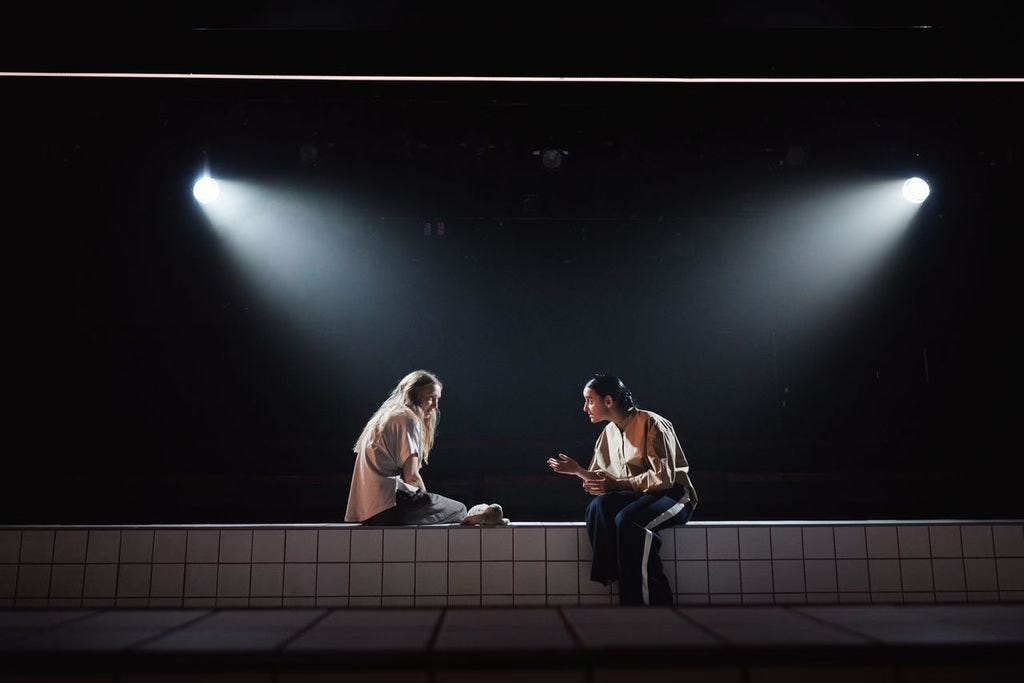
Playwright Georgie Dettmer on the inspiration behind her debut play Are You Watching?
In the weeks and perhaps years before the first draft of my play ARE YOU WATCHING? arrived, I had been consuming the horrors of various lives and geopolitical events from my phone. I wrote the first draft of the play in one go. I hadn’t planned to write it but woke up with a conversation between two young girls in my head, opened my laptop and began.
When the Gisèle Pelicot case reached me in the headlines of newspapers, I read everything I could. I watched videos of dead bodies, dead babies, dead landscapes across Palestine as the genocide raged on (and continues to rage on). I felt a mixture of horror, anger, apathy, helplessness, and rage. I felt so disconnected from the people I saw on my screen. At times, I was compelled to watch their tragedies unfold like some kind of witness. If I did not watch then surely I was complicit in the crimes enacted against them.
Other times, I scrolled past the barrage of images of death and sickness and pain. I scrolled on to nicer things. Things like where I should spend my time in North London, or how to communicate healthily with my boyfriend. In these moments, perhaps I felt like a bystander, ignoring the realities of the world in order to “protect my peace” or simply because, if I spent all day witnessing, I wouldn’t have time for anything else.
I know that my ability to look at and then look away from something is a sign of monumental privilege; to witness rather than to experience. I think all of this is compounded by our screens. By the glass cases with which we keep the rest of the world at bay.
For a while, I think I felt apathetic. I felt hopeless. With the introduction of the Police, Crime, Sentencing and Courts Act, I felt like our government had nigh on quashed our ability to freely, wholly resist their actions and complicity. I was scared. I felt cut off, a witness via a screen who could do nothing, and, at times, feel nothing.
I always say it feels like such a relief when I’m on my phone or laptop, scrolling, reading, and suddenly I feel so moved that I cry or shiver or feel anger rising within me. It feels like those moments are rare. I can watch the personal apocalypse of people across the globe: a dead child in a father’s arms and, afterwards, I have to get up and go to work. How is that possible? That should not be possible. But if I did not see it, if we did not see it, how would we know that the horrors persist?
My screen allows me to see the truth of the world, in all its grime and blood. It allows me to witness the pain of someone on the other side of the world and, hopefully, it allows me to speak, to act, to protest, to donate money, to boycott. None of this is simple. My screen distorts. It lies. It shows me unreal images. It shows me deepfaked images of women who cannot escape misogyny in online or real realms. My screen is an opiate. My screen allows me to think that I am doing something when, really, I am doing the bare minimum. My screen protects me. My screen exposes me. My screen dislocates me from my community. From other communities. There is no screen which can replace the body.
This is why ARE YOU WATCHING? has to be theatre. The only thing I said to Jess, our director, is that there should not be screens onstage. The screen in theatre is, I suppose, the fourth wall which (spoiler) is not as steady as it seems in ARE YOU WATCHING?. There is immense power in communing. In sitting with one another, breathing the same air and feeling our neighbours shiver and bristle and laugh.
ARE YOU WATCHING? takes what we see on our screens and places them in front of us - no glass protection. When the Police, Crime, Sentencing and Courts Act came into force in 2022, I had an immediate sense that theatre, both form and buildings, would have to become a place where anyone can come to feel, express, and hopefully be enlivened to make physical, tangible change. More than posting and reposting, but genuinely looking out to the world around them and reaching to.
This isn’t a diatribe against the Internet, by the way. I’m not an anti-internet luddite who wants us all to run off barefoot into the forest. Although that is how I spent my bank holiday. The internet calls to us to see, to watch, to witness and so we must. And then we must do more.
I think government crackdowns in the form of the aforementioned Act and the internet are obstacles to the most crucial, gorgeous, holy and hopeful of acts which is communion. Communing with others is how we enact change and it’s how we keep hope alive. Yeah sure, it sounds hippy dippy, and I promise you - the play is not hippy dippy - but nothing can replace all of us sharing a space together. In the streets, auditoriums, living rooms, meeting houses, community centres, parks, wherever. I used to watch and now, I try to watch and do.
Theatre is doing it in its purest form. We love to watch people do. And I think we are happier and healthier in ourselves for it. I have felt no more alive, hopeful, angry (not a bad thing), and moved than when I have been with people.
I sat and watched as Gisèle Pelicot spoke at the Southbank Centre for the launch of her new book, ‘A Hymn to Life’. As she walked on to the stage, the room - mostly women - rose from their seats and applauded her. We cried and we laughed and we smiled and we felt pain in our chest.
At an anti-fascist march, we cried and we shouted and we greeted one another because, in the act of congregating, we escaped the limitations of our screens and reached towards the world. Listen, I’m not convincing you to buy a ticket to the show, although I’m sure there will be a link at the end of this. I’m hoping to share with you how apathetic I felt, how still and stupid, privileged and hopeless I felt. And that if you feel like that as well, you can stop watching and you can start doing something else. Our world is bigger than the screen at the end of our fingertips.
Georgie Dettmer’s Are You Watching?, now in performances at the Royal Court to 4 July

Become a paid supporter
The Female Lead is a charity on a mission to empower women.
In the last 8 years, we have given access to books and teaching materials to 2.5 million students in 25,000 schools around the world. We carry out research that reframes our understanding of women’s experience, such as our Fulfilment Findersurvey which reveals what matters most to women at different life stages. It has now been completed by 150,000 women globally.
We can’t run the charity without your support.
For just £3.50 a month or £25 a year, you can make a huge difference.
Your donations allow us to continue to provide teaching resources and education to girls and women around the world, conduct groundbreaking research, and share science and stories online.
By pledging to make a donation, you get a host of other benefits like:
Access to our full archive of content on everything from advice from CEOs, to early menopause, to the brain impact of the mental load
Get the first look at our research reports busting myths around women
A virtual supporter badge to share and display online