


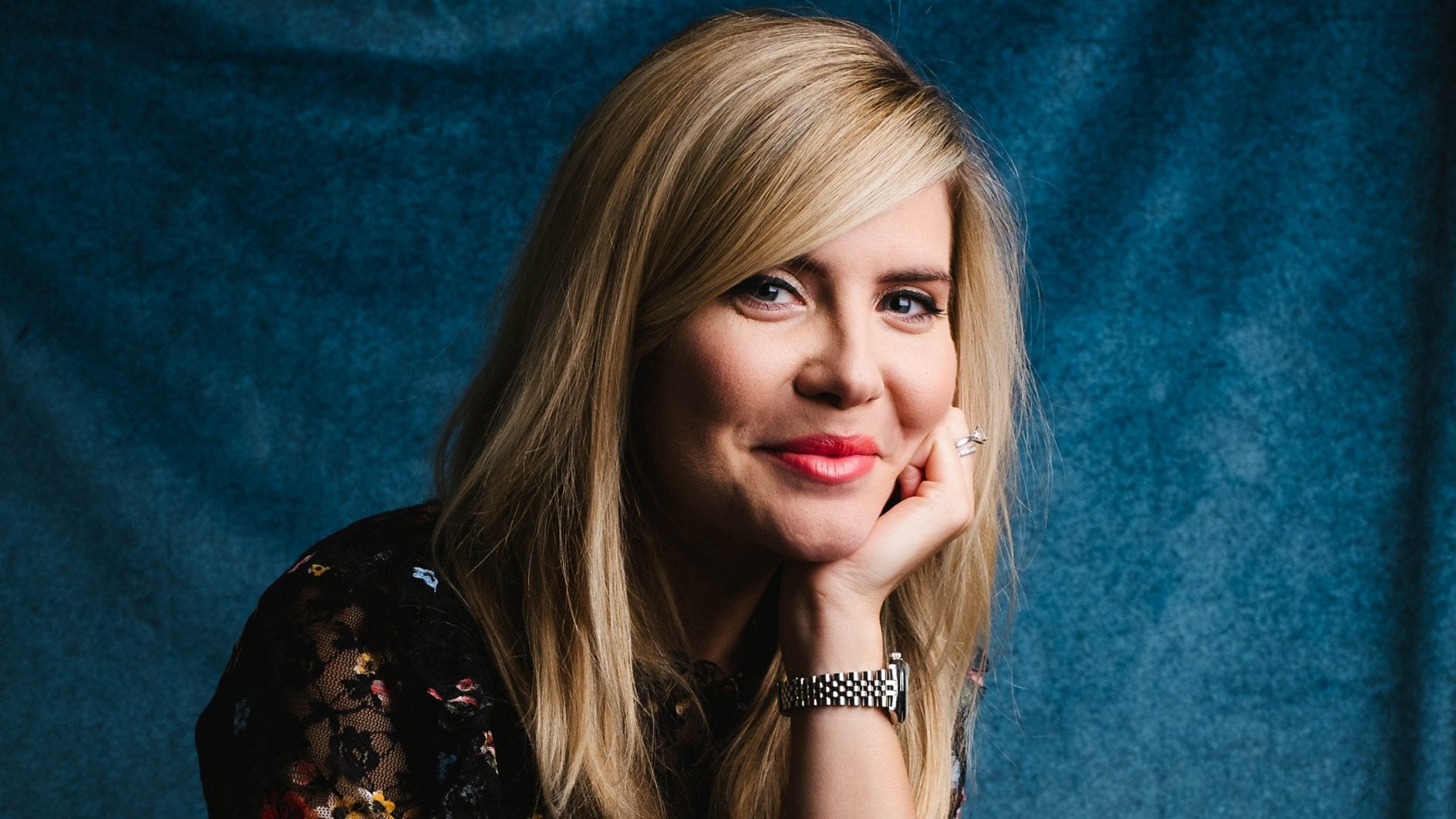
Temperatures have climbed to an almost unbearable 34 degrees in London by the time we arrive at the BBC studios to meet broadcaster and journalist Emma Barnett for her last interview of the day. As I clip on my microphone, she compliments my outfit. She’s warm, calm and generous.
She also has severe endometriosis.
Emma’s spent the day travelling across London in the heat, smiling for cameras and speaking to a steady stream of journalists about her new documentary. And chances are, she’s done much of it while managing the kind of pain she later describes as a “silent, invisible emergency”.
Emma was diagnosed with endometriosis at 31, but she has been living with symptoms since she was ten years old. Like many women with the condition, she is carrying a pain people cannot see. That invisibility is exactly what she set out to expose with her latest documentary, Emma Barnett: Fighting Endometriosis.
I ask Emma what she seeking to challenge with the documentary?
“Amazingly, it’s the first film of its sort in the UK, which I still am struggling to compute and believe,” she says. “I wanted to give it its importance. Endometriosis is not a small thing.”
According to the World Health Organization, endometriosis affects around one in ten women and girls of reproductive age worldwide - an estimated 190 million people. The condition occurs when tissue similar to the lining of the uterus grows elsewhere in the body, causing inflammation, scar tissue and often severe pain. It most commonly affects the pelvis but can also impact organs such as the bladder and bowel and, in rarer cases, areas outside the pelvis altogether.
Yet despite affecting millions, diagnosis remains notoriously slow. In the UK, it takes an average of nearly ten years for women to receive a diagnosis.
For Emma, diagnosis is only part of the story.
“It’s horrendous, of course, that it takes an average of ten years in a country like this to be diagnosed,” she says. “But what about afterwards? That would be like only talking about birth and never talking about parenting.”
The documentary follows that question. Alongside sharing her own experience, Emma speaks to doctors, researchers and women living with the condition, exploring not just diagnosis but the reality of life with endometriosis. Whether it’s making huge life compromises, dealing with constant uncertainty or the sheer amount of labour involved in managing a disease for which there is still no cure.
“It is a silent, invisible emergency,” she says.
Part of what makes endometriosis so difficult to understand is that its symptoms are often hidden. Severe menstrual pain, chronic pelvic pain, fatigue, digestive issues, infertility and pain during sex can all be symptoms. Some women experience debilitating pain that prevents them from working or attending school. Others become experts at masking it.
“I think we have to, as a society, get a lot more comfortable with taking people seriously with things that they can’t see,” Emma says. “It’s very difficult even in a medical setting to describe pain.”
One symptom Emma describes is a heavy dragging sensation in her legs. “It was so amazing when I met other women with the condition and they said, ‘That’s what I have.’ Because it’s not normal that you can suddenly not really easily walk up some stairs and you’re in your twenties or thirties.”
Despite commonly being discussed as a period problem, endometriosis is far more complex. “It’s not a period condition,” she says. “It’s not a gynaecological thing. It’s a system-wide inflammatory disorder.”
It’s an important distinction to make, since so many women spend years being told their symptoms are simply part of having periods.
Experts also suggest cultural attitudes play a role. Suzannah Weiss, author of Eve’s Blessing: Uncovering the Lost Pleasure Behind Female Pain, argues that many women have been conditioned to normalise suffering.
“Many women do not speak up when they’re experiencing pain because they’ve been taught it’s normal,” she says. “Many cases of endometriosis and other reproductive illnesses go undiagnosed because women are told to just take a painkiller or go on birth control instead of identifying the root cause.”
One of the documentary’s most striking themes is the burden placed on patients to become their own advocates.
“I can’t imagine other conditions where you have to assemble a squad,” Emma says. “You have to get a bowel doctor, a physio, a pain person, maybe a psychologist, all these different people and it is knackering.”
The emotional toll of that is difficult to overstate. Patients are often expected to manage appointments, treatments, symptom tracking and endless explanations while already living with chronic pain.
“It warps your relationship with medicine,” she says. “It warps your relationship with your own body.”
Perhaps the most devastating section of the documentary focuses on the choices women are forced to make because of their illness.
Emma speaks emotionally about Chloe, a young woman featured in the documentary. “I don’t think in 18 years of broadcasting, I’ve broken down. And her situation, it just touched me so deeply.”
Many conversations around endometriosis focus on fertility. Endometriosis is associated with infertility, and studies suggest that between 30 and 50% of women experiencing infertility may have the condition. But Chloe’s story reveals an even more painful reality.
“She could see she wouldn’t be well enough to be the mother she wanted to be,” Emma says. It isn’t a question of whether she could have children. It is whether she could live the life she wanted if she did.
I’m moved by the metaphor Emma uses to describe the condition’s impact.
“Endometriosis is a thief,” she says. “It steals from you. Sometimes it mugs you in broad daylight, sometimes it’s stolen stuff without you even realising.”
According to figures highlighted in the documentary, endometriosis costs the UK economy £12.5 billion annually through lost productivity and women being pushed out of the workforce. It’s this stat that Dr Lucy Whitaker from University of Edinburgh’s dedicated endometriosis research team believes will influence policymakers.
Having spoken to doctors and researchers throughout both her own journey and the making of the documentary, I was curious to know what Emma believes health professionals see as the biggest barrier to change.
“Ultimately it’s money and funding. That doesn’t mean suddenly somebody will figure it out, because there are places which have funding and they still haven’t figured it out. But I think it’s that mixture of urgency and funding coming together to get the best minds on this and for a long period of time.”


But Emma says that because endometriosis doesn’t kill you outright, it struggles to command the urgency afforded to other diseases, like cancer. Yet for millions of women, its impact can be life-altering.
The World Health Organization notes that endometriosis can contribute to depression, anxiety, social isolation, poor sexual health and reduced quality of life. Heavy bleeding can lead to iron deficiency and fatigue. Chronic pain can affect education, careers, relationships and family planning.
Emma adds, “It’s also really important for philanthropists, for those who have the ability to decide what gets funded and what gets the microphone and what gets the time to at least consider a largely silent and invisible force that is warping women’s lives the world over.”
“They don’t necessarily even want that much sympathy,” she says of people living with endometriosis. “They just want you to meet them where they’re at.”
As our interview wraps up, I ask what she’ll be doing next. After a day spent talking publicly about a condition she’s lived with privately for decades, perhaps Emma’s finally heading home to rest.
Of course not.
She’s got a doctor’s appointment.
Emma Barnett: Fighting Endometriosis is available to watch now on BBC iPlayer
