
‘Tourette’s Syndrome is my biggest challenge and greatest strength’
Teenager Lucy Gould on the reality of living with Tourette’s Syndrome


By Lucy Gould

Living with Tourette’s Syndrome is the best and worst thing that has ever happened to me. I am a mixed race, disabled teenager and none of those things have held me back. If anything, they have shaped me into someone determined to be seen, heard, and unapologetically powerful.
Tourette’s Syndrome (TS) is a chronic neurodevelopmental disorder defined by involuntary motor and vocal tics. I know that definition by heart. I was diagnosed with severe TS at 14, but I had already been living it. The best way I can describe it is like a sneeze - impossible to stop. Suppressing it feels like trapping pressure inside your chest until it burns.
I remember when I was 13 during a maths exam, I had a cold and needed to cough but I tried to hold it in, very aware of the silent hall. That pressure built until it exploded into my first tic attack. I slammed my hands and head against the desk. I don’t remember leaving the exam, but I remember going home and losing control - blinking, whistling, hitting my head against the wall. It was terrifying.
Then I had to give up a lot of things including swimming - something I loved, something that grounded me. Losing it felt like losing part of myself. These moments forced me to confront a reality I didn’t understand and couldn’t control. That is why Tourette’s can feel like the worst thing: because you are constantly learning how to exist in a body that doesn’t always listen to you.
But Tourette’s is also the best thing that has happened to me - because it gave me purpose.

It pushed me toward filmmaking, toward storytelling, toward creating spaces where difference is not hidden but celebrated. I don’t want people to just understand Tourette’s - I want them to understand people. All people. It is also freeing in the weirdest way possible as I don’t have the option to be anything but myself. There is no “perfect,” polished version of me to hide behind. Tourette’s strips that away. It forces me to be myself, unapologetically, even when it’s uncomfortable, even when I wish I could disappear into silence.
And somehow, in that lack of control, I found a different kind of control - the choice to own it.
I’m now 17 and have turned my experience into action. I wrote Tic, Tic, Boom, a story about a girl who sees her Tourette’s as a superpower. Writing it helped me process my diagnosis, but more importantly, it gave me a way to reach others. I am also developing a documentary, Tic by Tic, where people with Tourette’s can share their stories in their own voices. In the hopes of filming it soon I want to reach a global audience to help educate others on the condition and create a comforting and supportive community.
If you’re living with Tourette’s - or anything that makes you feel different - my advice is this: don’t make yourself smaller to make others comfortable. You are not the problem. Having a disability isn’t the problem but the way people treat you is.
You will spend so much time thinking, “What if people stare? What if I tic? What if I’m too much?” But the truth is, people will stare sometimes. You might tic a lot. And yes, you might be “too much” for some people - but you will be exactly enough for the right ones.
Related articles


It’s easy to say, “You shouldn’t care what others think,” but in reality, that’s one of the hardest things to do. So start small - care less. Choose one moment where you don’t shrink yourself. Then another.
Use what makes you different. Don’t hide it - shape it into something. Whether that’s art, film, writing, sport, or simply existing loudly in your own space, let it become yours.
Also, find your people. Even if it’s just one person who understands, that connection matters more than fitting into a crowd that never tried to understand you anyway.
I’m determined to educate as many people as possible. It’s not always a great conversation starter insulting someone or calling someone a “bitch”. But it allows me to say, “I’m sorry for calling you that but this is why”. That’s my way of starting a conversation - making people aware of it so it doesn’t come as a surprise and people know from the beginning but don’t feel obliged to do it. That’s just me.
Sometimes people are cruel, unjustified and rude because they are either uneducated, insecure or just miserable. So I will take a page out of my own book and - in my head, of course - stick a middle finger up to them. I don’t believe we should ever apologise for something you cannot control. You don’t see them apologising for something they can.
An example of this is the 2026 BAFTAs where John Davidson ticced a racial slur as Sinners stars Michael B Jordan and Delroy Lindo presented the first prize of the ceremony. That whole situation made me realise how the media and society treats disability and how powerless it made me feel. It fuelled me to advocate more than ever.
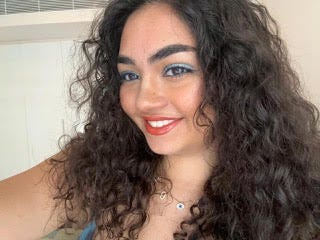
For anyone else living with Tourette’s I say this: You are not behind. You are not broken. You are building something different - and that takes strength most people will never have to find. You are fighting a battle no one else can imagine going through because they aren’t living your experience so don’t compare yourself to others whose challenges are different to yours.
Tourette’s is my biggest challenge and my greatest strength, equally a curse and a blessing. Yes, I swear a lot, and I’m weird even without my tics. So I will embrace every bit of myself no matter how hard it is. And I will keep using it - through film, through storytelling, through visibility - until no one with Tourette’s, or any difference, ever feels as alone as I once did.
You can follow Lucy on Instagram here.
