
This BBC documentary made me question every 'safe' space
Hidden camera abuse can happen to anyone, without us ever knowing. We spoke to investigative journalist, Jess Davies.

By Freja Love
After watching Jess Davies’ BBC documentary Hunting the Spyscammers, I found myself somewhere in the Venn diagram of paranoia, anger and disgust. To be honest I felt straight-up depressed.
As if women need another way to be violated. (I’m looking at you Meta glasses and generative AI 👀)
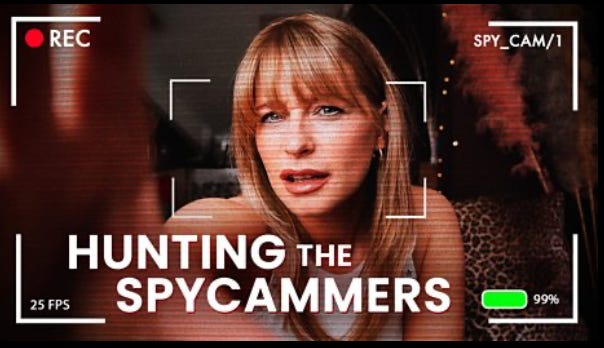
Hunting the Spyscammers investigates the hidden world of non-consensual hidden-camera abuse. It’s a subject Jess knows all too well because she’s a victim herself.
“When it comes to online harms, it can often be brushed off as, like, not that serious, not that deep. But as a victim of image abuse myself, and someone who’s campaigned in this space, it really is that deep.”
Jess was a student living in halls when a man she was dating photographed her sleeping naked and shared the image in a group chat.
“I have never, ever taken a fully nude photo that showed everything. Never one that I’ve consented to. That is the only image of me that exists like that. And that feels so incredibly violating, because that choice was taken away from me. You made that decision when I couldn’t consent.”
Voyeurism isn’t just inappropriate behaviour. Under section 67 of the Sexual Offences Act 2003, it can be a criminal offence to secretly observe, record or install equipment to film someone carrying out a private act without their consent for sexual gratification.
A private act includes situations where someone would reasonably expect privacy, such as getting dressed, showering, using the toilet or having sex.
In other words, secretly placing a camera in a bedroom or bathroom isn’t something that should be brushed off as a relationship issue or domestic disagreement. It can be a serious criminal offence.
It’s easy to dismiss hidden cameras as something out of James Bond or even an internet horror story but the reality is far more ordinary.
According to the charity, Refuge there has been a 78% rise in technology-facilitated abuse referrals.
Welsh Women’s Aid says the true scale of hidden-camera abuse is impossible to measure because many victims never even realise they’ve been filmed.
After watching the documentary I find these statistics very easy to believe.
It’s terrifying how easy it is to buy the technology needed to secretly record someone in an intimate setting. It’s even more terrifying how easy it is to hide.
As we chat, Jess starts pulling out examples.
A plug.
A coat hook.
A water bottle.
Each containing a hidden camera.
“It works exactly like an everyday plug.”
“And the clothes hook. I would never think to look for that.”
My immediate thought is: this really could happen to anyone, however careful you are.


Jess is careful to stress that the documentary wasn’t made to frighten women or place yet more responsibility on us to protect ourselves.
But she also admits that “it’s difficult not to feel paranoid.”
Since making the film, she now keeps a cover over her laptop camera whenever she’s not using it.
She even asked a security expert on This Morning whether she should check for hidden cameras whenever she stays in rented accommodation with friends.
While he was reluctant to tell people they should be doing it every time, he admitted that taking five minutes to have a quick look wouldn’t hurt.
“We all use public bathrooms. We all go round our friends’ houses. We all stay in hotels,” Jess says. “We can’t just say, ‘Don’t leave the house. Don’t go to the toilet.’”
Like millions of women, I’ve grown up internalising countless safety measures. text when you get home, keep your keys between your fingers, stay in well-lit areas, keep an eye on your drink. It shouldn’t be our responsibility, but they’re precautions many of us take anyway.
I never imagined that list might one day include checking a bedroom or bathroom for hidden cameras. That feels borderline dystopian.


One of the documentary’s most shocking revelations is that the perpetrators aren’t always strangers. Sometimes they’re filming the people closest to them.
“It all disturbed me. But to see these people saying things like, ‘I’ve taken betraying my wife to another level by trading the livestream’... they knew exactly what they were doing.”
“They were so casually discussing, ‘I started filming my sister’, ‘unaware wife’, ‘sleeping girls exposed’. If you’re sleeping next to someone, that’s probably somebody you know intimately.”
It’s almost too horrible to imagine.
But it’s also exactly why Jess wants to show that this isn’t a niche issue. It can happen to anyone and the people responsible aren’t shadowy internet villains hiding in basements.
“These are everyday people. They exist amongst us. Whether that’s in the workplace, whether that’s at home having dinner with your partner, your brother…”
I’m astonished to learn that many of the men sharing this footage didn’t believe they were doing anything wrong.
According to them, if the victim never found out, then no harm had been done.
It’s difficult to comprehend that level of entitlement, Jess and I agree.
How can someone believe there’s no harm in secretly filming another person changing a sanitary pad, using the toilet or walking around their own home naked?
It’s such a profound betrayal of trust.
Jess has spent years investigating abuse against women, from AI deepfakes to image-based abuse and she’s come to an unsettling conclusion:
“I think the fact that this content isn’t consensual is what drives a lot of it.”
She believes an internet constantly pushing people towards more extreme material has helped create an environment where violating someone else’s consent becomes part of the appeal.
“There’s so much content out there now that people are searching for more extreme content. And, as with the internet, you’re always going to find it.”
Jess isn’t under any illusion that one documentary is going to solve the problem.
Technology will keep developing. What we need to look at, she says, is whether we’re asking enough questions before we unleash it.
“We have to be creating technology with safety by design, rather than trying to put the genie back in the bottle once the damage is done.”
Her hope is that the documentary starts a wider conversation about consent, accountability and whether devices designed to secretly record people should really be this easy to buy.
She’s also realistic about where enforcement should focus.
Online communities dedicated to sharing this material aren’t going to disappear overnight. But making them harder to find matters.
“If you have to jump through a VPN, if you have to be invited into these groups that keep getting shut down, then you know what you’re doing isn’t right. It just makes it that bit harder to access.”
The documentary is fascinating and I would highly recommend that you watch it if you haven’t already but I can’t help thinking that this is another burden women shouldn’t have to carry. Another way our privacy can be stolen.
And yet, pretending it isn’t happening won’t make it disappear.
Jess agrees.
“As with so many things, until legislation and societal culture catch up, sometimes you have to put your own safeguards in place.”
Watch some of our interview with Jess:
Hunting the Spycammers is available to watch on the BBC's YouTube channels and BBC iPlayer.
