

Trigger warning: this article contains references to sexual assault that some readers may find upsetting.
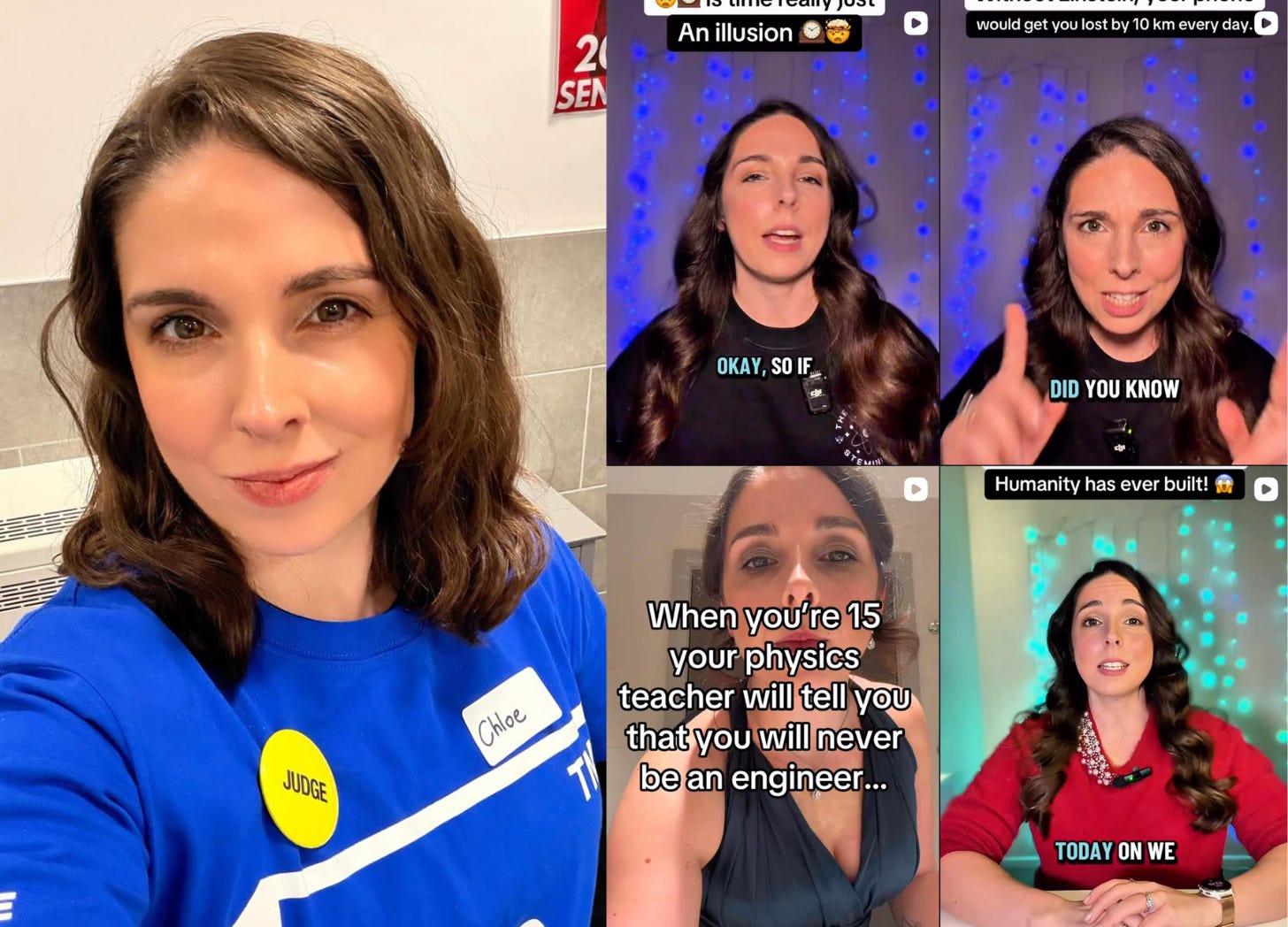
Chloe Lipton has always been the kind of person who wants to know how things work. Long before she became better known online as @everydaysteminist, she was dreaming about becoming an inventor.
“I love puzzles,” she tells us. “I’ve always had this curiosity of wanting to know how everything works.”
That curiosity eventually led Chloe towards engineering, with her sights set on becoming an engineering officer in the Air Force.
“That’s what I'd always planned for,” she admits.
It was a career that combined two things she cared about.
“I wanted a sense of purpose and to help people,” she explains. “And being an engineer, I felt that I would be helping to defend.”
It was a clear plan for her entire life. Then, just before her final university exams, Chloe was violently sexually assaulted. She describes the attack as so horrific that she was “almost killed”.
Somehow, she still managed to pass her exams and make it through her first phase of military training. But during that training, she began experiencing symptoms of PTSD.
After being diagnosed, Chloe was told she was no longer “medically fit for service”. The career she had spent years working towards was suddenly taken away from her.
Losing her place in the Air Force didn’t make her fall out of love with engineering. If anything, it gave her a different way into STEM.
“I still loved engineering, and I still loved science,” she says. That passion eventually drew Chloe towards STEM outreach and posting to social media about her experiences, where she began to witness the wider barriers women face in the industry.
And with that @everydaysteminist was born.
Now, Chloe has built a platform to make science and engineering feel less intimidating, while talking openly about the gender inequalities that exist within STEM. Her “big, big mission,” however, is to make “STEMinism as mainstream as feminism”.
Whilst she does want to get more women interested in science, ultimately, she hopes to make science feel like it belongs to everyone.
“I don’t think people realise how much it affects us as a society. It’s something that affects everyone.”
One of the biggest problems Chloe sees starts surprisingly early. At school, she says, children can quickly absorb the idea that STEM is only for people who are naturally brilliant at maths and science.
“If they’re not top set maths or top set science, they feel like they can’t study STEM,” she says. “There’s so much more to it than that.”
Chloe is particularly keen to challenge the idea that academic ability is the defining characteristic of a good scientist or engineer. Crucially, STEM can rely heavily on creativity and perseverance - which can matter “way more than academic ability”
Knowing this from early on matters because when STEM is presented as something you’re either naturally good at or completely incapable of, it creates an “us or them attitude”.
And Chloe believes that distance from science can have consequences far beyond career choices.
“If science feels inaccessible to people, it leaves people vulnerable to things like conspiracy theories,” she explains.
Part of what makes conspiracy theories so effective, she argues, is that they take complicated scientific ideas and turn them into simple-sounding explanations that feel convincing, whilst actually getting the facts wrong.
“Conspiracy theories are so clever,” she says. “They take stuff that sounds complicated, like quantum theory, and they explain it in a way that is wrong, but sounds simple and makes people feel smarter for understanding it.”
“And also STEM is amazing,” she adds. “Everyone should be able to understand it; it’s so cool.”
🚀 Women are taking up space, literally

It was once one small step for man, but in 2026 it’s one giant leap for women.
Of course, making STEM feel accessible is only part of the problem. Women who do enter STEM are still more likely to leave, something Chloe describes through the idea of the “leaky pipeline”.
The reasons women leave, she says, can look very different from the reasons men do. While men may leave for better opportunities or promotions, women can feel pushed out by workplaces that overlook them or fail to accommodate responsibilities such as childcare, which still disproportionately fall on women.
And those attitudes can begin forming long before anyone enters the workplace.
Chloe mentions the “draw a scientist” experiment, where children are asked to draw a scientist. While younger children increasingly draw women as scientists, that representation drops off as they get older.
Chloe feels this is a clear sign that the problem isn’t girls suddenly deciding they don’t like science but that societal stereotypes start to creep in.
“There’s nothing about STEM that is gendered,” she says. “It’s about problem solving. And women and girls perform just as well as boys and men, if not better in some cases.”
Yet when young women look at a male-dominated industry and don’t see many people who look like them, it’s easy to wonder whether they belong there.
“They either see it as, ‘I don’t know if I’ll fit in’ or ‘I just don’t see myself here because I don’t see enough women.’ So you subconsciously start to think I don’t belong.”
That’s why Chloe is so excited by the growing number of women making science communication their thing. She names mathematician and broadcaster Hannah Fry as her personal hero, admitting she was “far more excited” when Fry followed her on Instagram than she would have been if an A-list Hollywood actor had done the same.
She’s also a fan of the women creating science content online, including Ellie Sleightholm, who Chloe praises for her coverage of the Artemis II launch.
“The astronaut Christina Cook as well.” She adds. “Incredible.”
Although she had never thought of the industry as gendered as a child, Chloe’s own experiences in STEM have also taught her that getting women into the room is only the beginning.
There have been times in her career when she’s been treated differently because she’s a woman. She remembers suggesting an idea only for it to be dismissed, before a male colleague repeated almost exactly the same thing minutes later and suddenly everyone was interested.
She admits that earlier in her career she didn’t always know how to respond. Now, she says, she’s much better at standing up for herself.
“I think as women we just need to be better at backing ourselves.”
And, in perhaps her most memorable piece of advice, “have the confidence of a mediocre white man.”
It’s funny because it’s true… and because Chloe’s point is really about something much more serious. Often, women are taught to question whether they’re being too sensitive or too demanding when they call out unfair treatment.
“You’re not overreacting,” she says. “If you feel like you’ve been spoken over, just back yourself. If you can do it from day one, you’re putting yourself in a much better position.”
For all the discussion around inequality, Chloe’s enthusiasm for STEM is infectious. It’s clear that her advocacy isn’t driven by a dislike of the industry. Quite the opposite.
She genuinely loves this stuff.
“I’ve literally held things in my hand that are going to the moon in the next couple of years,” she says. “I can’t explain how cool that feels.”
“When you have someone who’s a bit misogynistic and assumes women can’t change a tyre, I’m like, ‘actually, I’ve built this whole thing. You can shut up.’”
She works on projects connected to space, helping to develop things that could contribute to our understanding of the universe. And for Chloe, there’s something particularly exciting about knowing that there will always be another question to answer.
“You’ll never run out of stuff to learn. It’s incredible.”
And, as a woman in engineering, there is one more perk.
“I think one thing especially about being an engineer, especially as a woman, is being able to fix things,” she says. “Especially when you have someone who’s a bit misogynistic and assumes women can’t change a tyre. And I’m like, ‘actually, I’ve built this whole thing. You can shut up.’”
Honestly? We can’t think of a better STEM lesson than that.
