
36% of women drink beer. So why are only 7% of brewers women?
Why breweries can't afford to ignore women anymore.

More than a third of women in Britain drink beer, yet we make up just 7% of the people brewing it.
That’s one of the biggest takeaways from this year’s Society of Independent Brewers (SIBA) Independent Beer Report. Rachel Auty, founder of Women On Tap, says the stat reveals a bigger problem than just representation.
Women actually make up 31% of the indie beer workforce, but they’re overwhelmingly concentrated in support roles such as marketing, administration and accounting. In fact, 72% of admin and accounting staff are women, while the industry’s core creative role - brewing itself - remains almost exclusively male.
“We’re running the spreadsheets, not the mash tuns,” Rachel says. (A mash tun is a brewhouse vessel used in brewing and distilling that mixes ground malt with temperature-controlled water.)
She believes it’s a culture problem.
“It’s a space built for men still,” she says. “How can we change this to make it more appealing to more people?”
The figures show demand is there. Around 36% of women now say they drink beer, up three percentage points on last year. But Rachel believes the industry producing that beer still doesn’t reflect the people buying it.
“We’ve said it before and we’ll say it again,” she wrote following the report’s release. “Without the representation of women and the inclusion of women’s perspectives in the workplace, it’s incredibly difficult to engage women as consumers.”
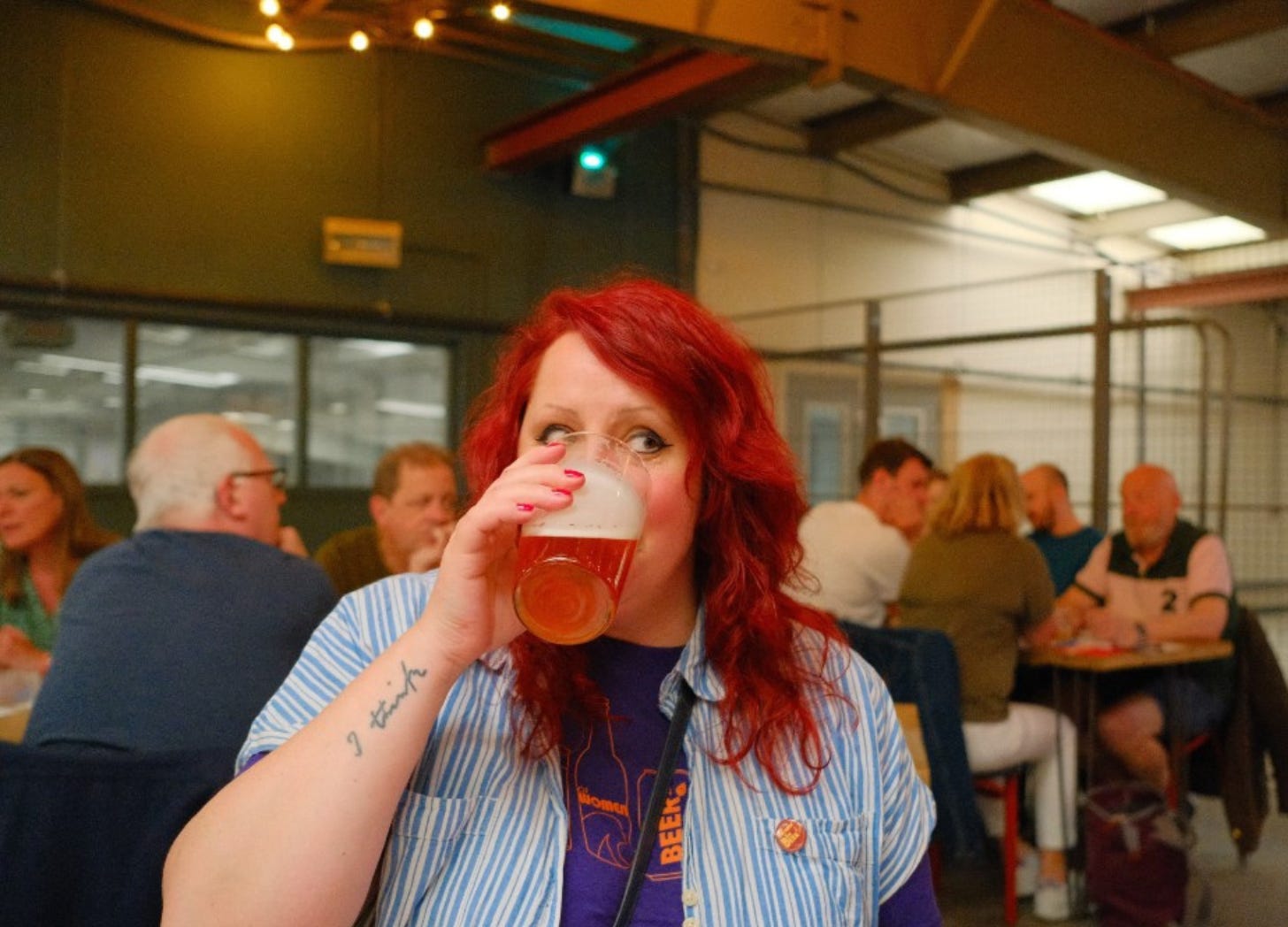
She remembers going to the pub with her dad years ago, back when, as she jokes, “beers were brown”, and constantly being questioned for ordering a pint of ale.
“Everybody used to be like, ‘A woman? Why are you drinking pints?’”
Surrounded almost entirely by older men, she couldn’t help wondering where the women were.
“Do women brew beer? Do women run breweries? What the hell is going on in this space?”
Those questions eventually led her to launch Women On Tap in 2017, beginning with a small festival in Harrogate showcasing beers brewed by women.
“I’m passionate about being a voice for women, tackling those male dominated spaces that bring with them all sorts of problematic beliefs, behaviours and perceptions”
“Lots of women said they still didn’t feel welcome in pubs.”
Women On Tap works across three key areas: representation, connection and improving workplaces, helping women build networks while pushing the industry towards meaningful change.
“We always joke that our goal is not to need to exist.”
Rachel says the low number of women brewers isn’t down to a lack of interest, but the environments many women find themselves in. Women On Tap has recently heard from women attending festivals and industry events who have been spoken to “inappropriately”.
“Some blokes clearly think that it’s still okay to behave in that space as if it’s owned by men.”
That’s why the organisation has become a visible presence at festivals and trade events, including as a purpose partner for this year’s London Craft Beer Festival on the 17 and 18 July.
Use our code ‘femalelead’ for £15 off tickets!
“We’re saying, ‘No, it’s not your space, we’re very much here,’” Rachel explains. “You can’t do that anymore. You can’t get away with it.”
She hopes that visibility reassures women that “we’ve got their backs”. Even now, she admits, industry events can still feel intimidating. “It’s just a way of saying, ‘We see you, and we’ve got your back.’”
While there are signs of progress elsewhere, Rachel says the brewing numbers are still moving in the wrong direction.
“I think a lot of women have been feeling quite disillusioned and unsupported and have left,” she says. “I know women myself that have left the industry completely for these reasons.”
Instead of asking why women aren’t entering brewing, Rachel believes employers should be asking why they’re struggling to stay.
“We need to create this culture where women are actively supported in these roles.”
Women do make up 50.3% taproom staff, making them the majority in this space, which Rachel says is “brilliant.” But her concern is that “bar work is more accessible to women who want to work in beer and see limited options to do so”
“Heineken are currently working on some women’s brewing experience days that we’re working with them on. So that’ll be really interesting because obviously when it’s a name that people recognise, it ends up being quite impactful.
“On a smaller scale, I’ve seen breweries that have paid for their women staff to do some specific training as a bit of a targeted initiative”
“Progress is happening in very little pockets but not across the board.”
Another barrier she recognises is that for decades, beer has largely been marketed by men, for men.
Rachel mentions everything from sexist pump clip names to working men’s clubs and advertising that has historically suggested women weren’t the intended audience.
Many women decided beer just “wasn’t for them”.
Women are expected to control around 75% of discretionary spending by 2028, making them one of the most influential consumer groups. Rachel believes breweries that fail to engage women are missing a huge commercial opportunity.
“If you’re a beer brand or brewer you want women to buy beer and you want them to be choosing your beer.”
Plus, “if there are more women going into the industry and being that representation piece, then there are going to be more women drinking it,” she says.
“That means more customers.”
She mentions Guinness’ recent popularity among younger women, fuelled by influencer marketing, as proof that perceptions around who drinks beer are beginning to shift.
Related articles


There are definitely reasons for optimism.
For the first time, SIBA collected data on brewery ownership in partnership with Women On Tap, revealing that 21% of brewery owners are women.
Rachel explains that figure is encouraging, but says it still raises questions about how much decision-making power women really hold.
Women On Tap also continues to grow.
After taking over International Women’s Collaboration Brew Day last year, the organisation helped increase participating brew days from 61 to 88 in a year. The campaign also raised £33,000 for women’s causes this year, up from £27,000 the previous year, while a new bursary scheme is helping women overcome financial barriers to entering the industry.
Ultimately, Rachel wants women who are curious about a career in brewing to know they don’t have to navigate it alone.
“It’s such an incredible community of amazing women that have got your back. There are opportunities all over to take advantage of, and there is support to help get your foot in the door and then help you progress.
“We hope that support will increasingly come from workplaces, but for now it comes from people like us. There’s a great community of really passionate people, and it’s a very rewarding career when you can get yourself in there.”
You can discover some of the UK’s best independent breweries at the London Craft Beer Festival, taking place in Southwark on 17 and 18 July, where Women On Tap is a purpose partner. The Female Lead readers can get £15 off tickets using the code ‘femalelead’ when booking.

Walking into an environment where you are constantly adapting to fit the baseline behavior of others takes a quiet, physiological toll. True inclusion isn't just about putting women on the payroll; it is about creating a workspace where their nervous systems don't have to stay in a constant state of hyper-vigilance just to do their job
And should we be encouraging it either way? Not a popular thing to say out loud, and sometimes people get defensive about it, but there are zero health benefits to alcohol. Zero.This is one area where perhaps we leave men to it. 🤔