

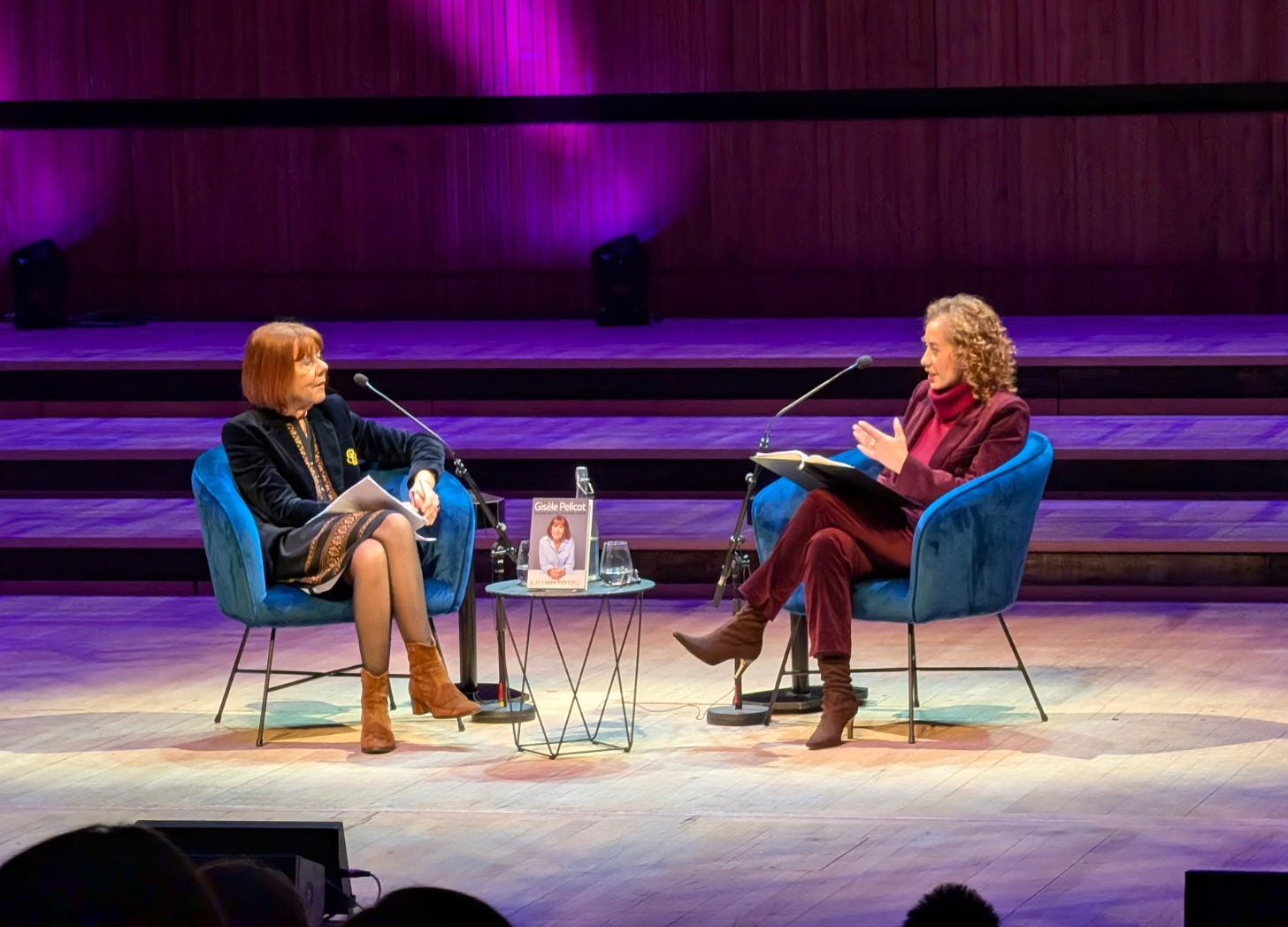
Gisèle Pelicot’s story horrified and inspired millions of women around the world when she waived her right to anonymity as the victim in the French rape case in 2024. Between 2011 and 2020, Gisèle had been drugged and raped by her husband Dominique Pelicot and dozens of other men while she was unconscious.
Now, she is telling her story and The Female Lead attended the UK launch of her book, A Hymn to Life, to hear from Gisèle in her own words.
The evening started with readings from the book from actresses Juliet Stevenson, Dame Kristin Scott Thomas and Kate Winslet. The audience listened in rapt silence until Kate Winslet read aloud, “Everyone needs to see the faces of the 51 rapists; they should be the ones to hang their heads in shame, not me”, which was met with a huge round of applause, the first of many moments from Gisèle that would move the audience.
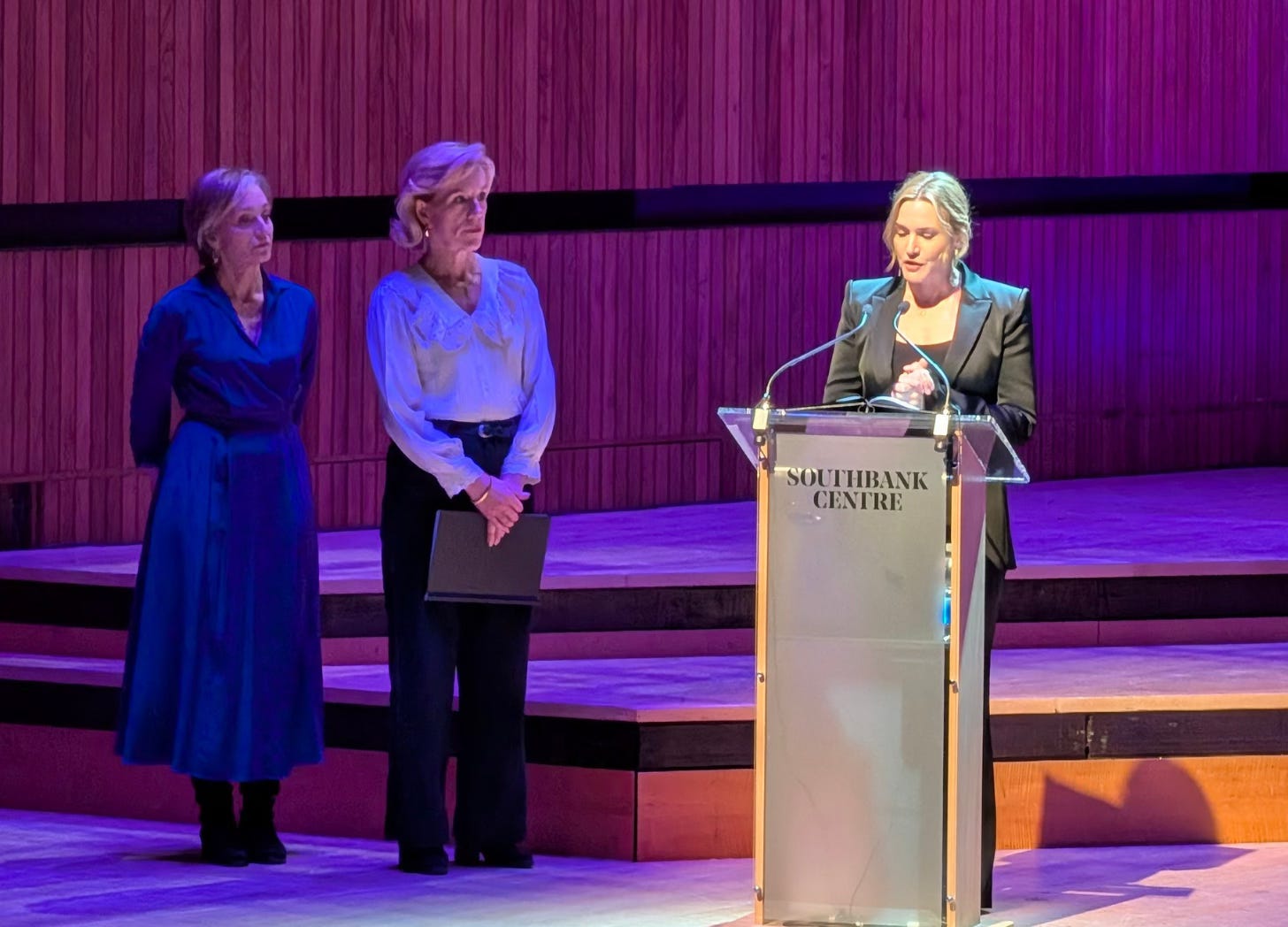
It must take immense courage from Gisèle to sit and hear her trauma relived outloud for hundreds of audience members. She is very open about the fact that she hasn’t traditionally viewed herself as a feminist figure, discussing how she was happy with her husband and content with their traditional life.
When speaking about her ex-husband, Gisèle is calm and collected, referring to him always as ‘Monsieur Pelicot’, which might even seem confusing for a listener, but also speaks to her resolve that she will not let him or rage be her definer.
When he was arrested for upskirting in 2020, Gisèle initially apologised for her husband’s behaviour, embarrassed that he could do something so awful. “There was this A side to him: a benevolent, good-intentioned man with friends who admired him. And this second side B: that was the worst side of human nature. This is exactly what came out. I tried to bring him into the light, but he had this dark side,” Gisèle says.
She used the event at the Southbank Centre in London as a chance to platform and educate about the dangers of chemical submission, speaking about when she repeatedly went to the doctors knowing something wasn’t right, they said she may have early signs of Alzheimer’s, or have had a stroke.
“I hope now there’s more awareness and more knowledge about chemical submission because this is a tool of violence, and we need to make this clear,” she says.
Gisèle emphasised that this issue, and violence against women and girls, is not confined to France. The problem is universal. Young people, she warned, must be cautious online. Society, she argued, remains in denial.
“We are in a patriarchal society. We need to change this. Young generations will help to change this mindset,” Gisèle says.
Violence against women and girls (VAWG), she insisted, is not political, saying, “Some people may think it is depressing. But it is not political. It is important to talk about violence.”
Even with evidence, the courtroom experience was brutal. “The victim is considered guilty, and the defendant wants to be victimised,” she explains. The presumption of innocence persisted, despite proof. She describes photographs of her abuse being referred to as “sex scenes” rather than rape scenes, and how this was something that made her incredibly angry.
Gossip around her family has been rife in the media, and Gisèle used the evening as an opportunity to speak out on it in her own way.
“All of this was very, very painful for my children. This trauma didn’t bring us together. It’s not true that trauma always brings a family together. It really pushed us apart. We are trying to get our family back together. I spent time with my grandson yesterday. We are speaking now a lot. I spoke to my daughter before I came here. She gave me encouragement. So it’s great that we are coming back together. I’m so proud of her because she has created her own association now to support victims of chemical submission. I’m proud of this,” Gisèle says.
Despite the trauma she’s endured, Gisèle wanted to impress that she’s living a happy life, on her terms. She’d repaired a friendship with an old friend that had crumbled due to her ex-husband’s behaviour. She discussed meeting the security guard who had originally caught her ex-husband upskirting, and told him how his actions had saved her life. And she’s found love again. “I did not imagine falling in love or even, like, wanting to fall in love because, you know, when you go through what I’ve been through, I thought my life as a woman was over,” she says.
In a lighter tone, Gisèle laughed about how she binge-watched The Queen’s Gambit. “I really managed to sort of go back to my life as a young woman, if you like, living alone, and I could watch this series. It was a kind of freedom for me. I think I stayed up until five o’clock in the morning watching,” she says.
Gisèle chooses to live her life without regrets, which, like many statements said in the evening, led to thunderous applause. “I think it’s very important not to have any regrets, life is like this. I just think that today, I’m very lucky to be with you today, and he has been sent to jail. That’s my positive side.”
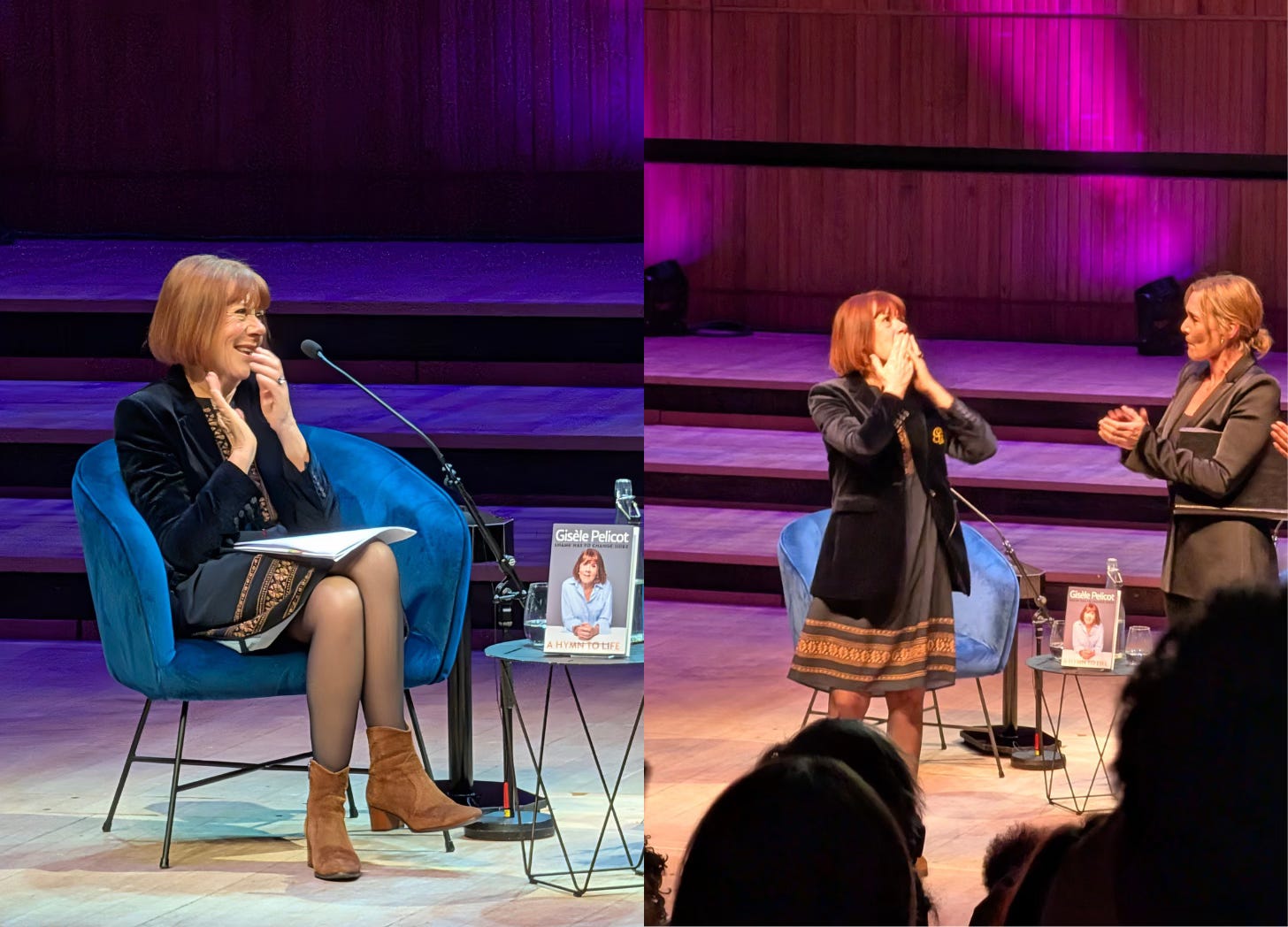
She wrapped up the event, speaking about what she wants next for her life:
“I am now 73. I hope I can continue my life serenely, quietly. I’ll be here to always listen to women who need support. I’ll always be here.”
What followed was a standing ovation that lasted three minutes, and likely would have lasted ten more had Gisele not left the stage, waving and blowing kisses to her audience.
A Hymn to Life is out now.
Some resources for survivors of violence:
Rape Crisis England & Wales: 0808 500 2222
USA National Sexual Resource Violence Resource Center: TOLL-FREE 877-739-3895
International support resources: takebackthenight.org
