


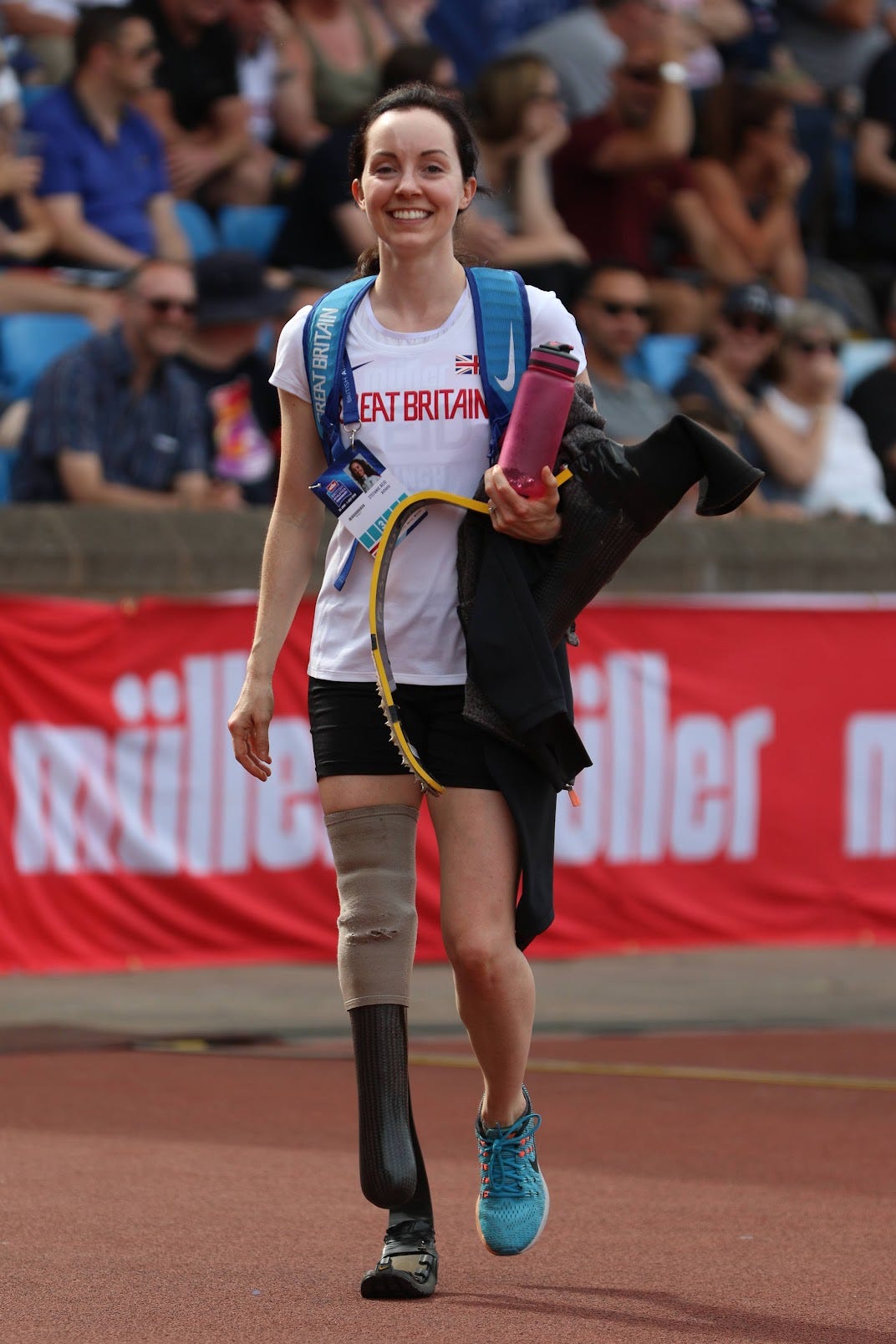
Stefanie Reid MBE doesn’t call herself a disability campaigner. In fact, she actively resists the label.
“I think there’s a big issue as soon as you start segmenting the population into people with disabilities and people without,” she tells The Female Lead. “What I advocate for is every single person being able to find themselves existing in an environment that allows them to reach their full potential.”
That distinction matters. Because Stef - paralympian, broadcaster, keynote speaker and executive coach - isn’t interested in rage for rage’s sake. She’s interested in solutions.
The former Paralympic sprinter and long jumper, who lost her right leg in a boating accident just before her 16th birthday, took up recreational running after retiring from elite sport. While searching online for a new pair of high-performance trainers in early 2024, Stef hit a familiar frustration: she only needs one running shoe.
“The Nike trainers I was recommended by friends at parkrun were between £200 and £250,” she says. “It’s not that I’m opposed to funding my hobby, but it’s so frustrating when I’m literally going to throw half of this away.”
Then Stef remembered Nike had displayed their running gear on amputee mannequins with a running blade like hers. “It was so cool to see the inclusivity. My sister sent me photos of models with a blade like mine in a store in America and a friend spotted it in Nike’s London store a month later,” Stef says. “Obviously, somebody in that store had to dress that model with one shoe and they would have realised there’s one shoe leftover.”
So she contacted Nike to ask whether she could buy a single shoe or receive a discount. The answer was no.
“At one point they offered me a one-time 15% discount,” Stef says. “And I was like, ‘That’s great, but I’m still going to have this problem for the rest of my life’.”
What happened next resonated far beyond the disability community. Stef shared her experience online and the post exploded.
“It wasn’t actually primarily people with disabilities reposting,” she explains. “It was an entire population of people who wanted authenticity from brands. They want companies to live out their values.”
That point feels particularly powerful in an era where inclusivity is often used as a marketing strategy. Stef’s criticism was never about “calling out” one company for the sake of it, it was about asking whether representation means anything if systems don’t change alongside the marketing.
“I specifically targeted brands who were using amputee runners in their ads,” she says. “Your marketing has to match your actual practices in life.”
Nike later reached out privately to Stef and had “really productive conversations” with her. “I firmly believe when things like this happen, it’s not because somebody was sitting in a room thinking, ‘This is what we’re going to do.’ They just didn’t think about it,” she adds.
That’s where Adidas entered the story.
Following renewed media attention around Stef’s campaign, the sportswear giant quietly contacted her in early 2026. “They said, ‘We don’t want anything from you. We just want to tell you what we’ve done and get your input’,” she recalls. “It was this really lovely, humble conversation.”
Adidas had introduced a single-shoe service for amputees without launching a huge marketing campaign around it. “They said, ‘We know it’s not perfect, but we’d rather try.’”
So Stef decided to test it herself. Quietly. She visited an Adidas store in London as a regular customer. What happened next is the kind of story that changes industries because of how simple it is.
“I went to the till and asked for the single-shoe service,” she says. “And the staff member’s face lit up. She said, ‘This is so exciting, I was just trained on this two weeks ago and this is the first time I get to use the code’.”
“That was the thing that impressed me most,” Stef explains. “They’d actually gone through and done this properly. I do love that Adidas was paying attention.”
The interaction itself stayed with her too.
“She stumbled over her words a little bit and said, ‘I’m really sorry, I don’t know how to ask this properly, but I need to make sure I’m putting the right shoe in the box.’ And I was like, ‘Yes, that is a very important question, ask away’.”
Stef walked out carrying one trainer. “It really was that simple.”
But the bigger issue Stef raises goes far beyond amputees.
“More than half of the adult population has feet that aren’t the same size,” she points out. “For most people it’s fine, they go half a size up and get away with it. But for a lot of people it’s more than that. You’re either buying two sets of shoes or wearing shoes that don’t fit.”
To her, this is about rethinking the entire fashion industry’s relationship with bodies, accessibility and sustainability.
“Nobody’s body fits this one standard,” she says. “And yet that is what the entire fashion industry is based on, a concept that simply isn’t correct. But consumers think, ‘If you’re going to treat everyone with respect, you’re probably going to treat me well too’.”
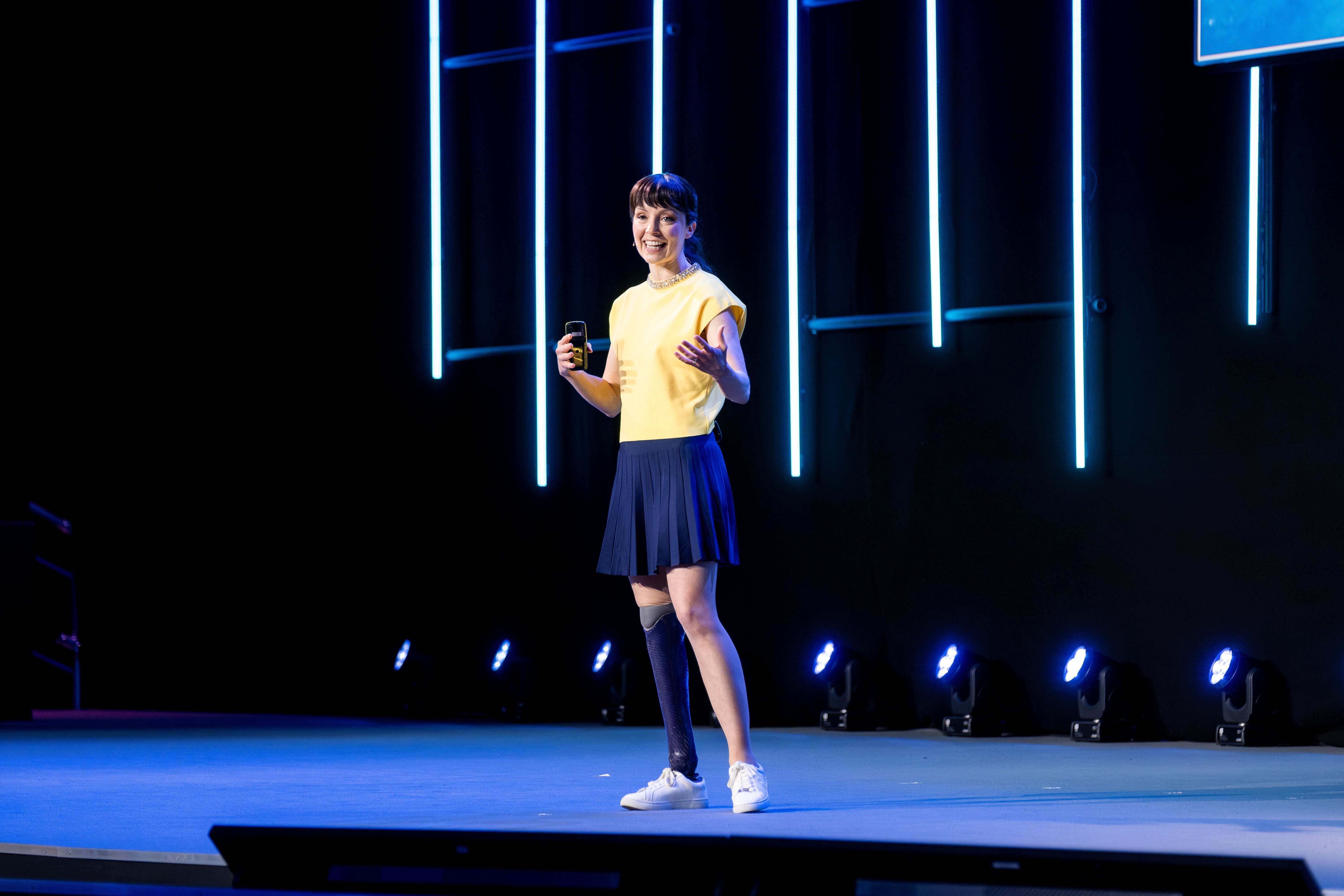
It’s impossible not to connect this mindset to Stef’s boat accident as a teenager. Her life was saved by a surgeon in Toronto, Canada who amputated her right leg below the knee. Surviving the trauma changed her perspective entirely.
“I spent a significant portion of my life in the able-bodied world and gave very little thought to people with disabilities,” Stef says. “I think of my life in terms of ‘before’ and ‘after my accident’. I realised life is fragile. You face death and it changes your perspective on everything. I emerged as a very different person because my priorities changed. It’s life altering and life affirming. But I could have lost every limb on my body and I still would have been me - competitive.”
Related articles


The experience transformed Stef’s relationship with risk and failure. “The worst has happened,” she says simply. “So this can’t be so bad. Let’s just try it.”
It’s now the philosophy behind her Hail Mary Friday Club, where people challenge themselves to do something bold every week.
“Every Friday you do something you’d usually consider too bold or audacious for yourself. They usually don’t work out but that’s not the point. It’s just like inoculating yourself to failure. My accident was super unfortunate. But you realise that at rock bottom there’s actually quite a lot of power,” Stef says. “Because you don’t have anything to lose.”
Stef’s message isn’t about striving for perfection. It’s about building systems that make everyone feel seen.
And sometimes, that starts with something as ordinary as buying a pair of trainers - or just the one you need.
Learn more about Stef and the Hail Mary Friday Club here.
