
Getting heard at the real-life round table
What The Traitors can teach us about finding your voice outside the castle walls

The Traitors quickly became must-see TV with contestants taking to the now iconic round table to debate, strategise, plead their cases and desperately try to get others to listen.
If the castle residents fail to get their voices heard, the consequences are dramatic: someone is banished from the game and forced to leave, only then revealing their true identity as a Faithful or Traitor upon their exit.
And look - it is undeniably a gripping TV moment. But the stakes, and the dynamics, mirror something all too familiar for women. In everyday life, women regularly find themselves caught in variations of this same struggle; they have ideas, insights and solutions, but too often are interrupted, talked over or just plain dismissed.
We see this play out from childhood classrooms to workplace boardrooms. And not being heard doesn’t just feel frustrating, it has real world consequences. We’re talking about missed opportunities, overlooked expertise, and inequality baked into everyday interactions.
So, this week, we’re unpacking why women’s voices sometimes struggle to land with the same weight as men’s, what we can learn from research and lived experience, and how we can equip the next generation with strategies to be confident, clear, and listened to.
👂The listening gap
Recent UK research and reporting shows that:
Women are more likely than men to be interrupted or spoken over, particularly in mixed-gender discussions (BBC Worklife, 2023).
In professional settings, women report that their ideas are frequently ignored until repeated by someone else, often a male colleague, a pattern widely recognised in UK workplaces (Harvard Business Review, cited by BBC, 2023).
In schools, studies show that boys dominate classroom talk, speaking more often and for longer, while girls are more likely to self-censor or wait to be invited to speak (OECD via The Guardian, 2022).
When women do speak assertively, they are more likely to be judged negatively, described as “bossy”, “emotional” or “difficult” — labels far less commonly applied to men for the same behaviour (The Guardian, 2023; Chartered Management Institute, 2022).
And these aren’t just isolated moments, they’re systemic patterns that begin early and follow girls into adulthood - into meetings, interviews, relationships and decision making spaces.
This is more than ‘being confident’ - this is about being in environments that know how to listen.
Resources
For teachers & educators:
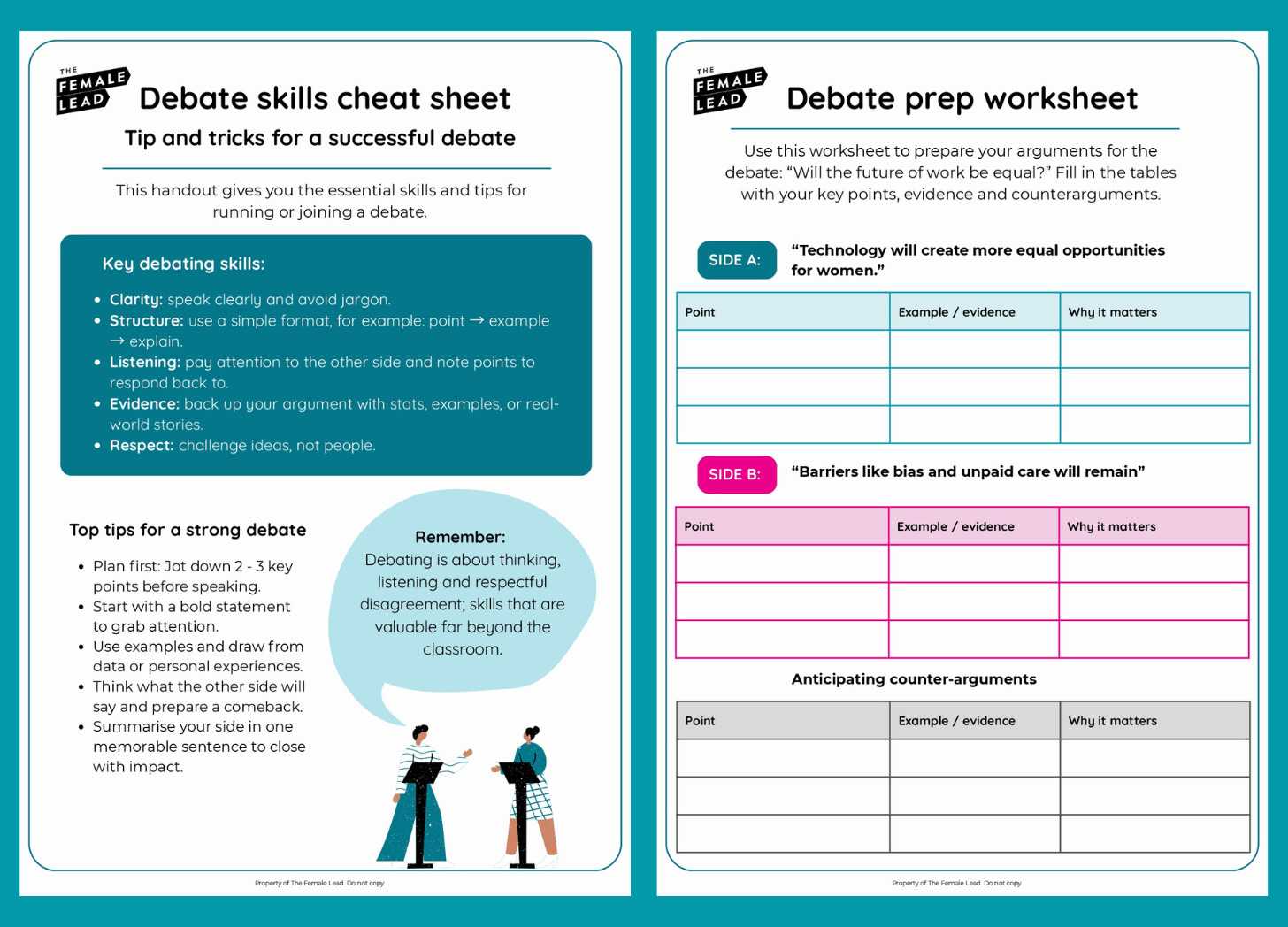
👉One of the most powerful ways young people learn to use their voice is through structured debate - not shouting, not winning, but thinking, listening and being taken seriously.
These two worksheets are designed to help students practise exactly that.

Conversation starters for parents & guardians:
Helping young people find their voice isn’t about telling them to speak louder, it’s about helping them notice when they feel heard, and when they don’t.
Try things like:
“That meeting / class looked intense… did you feel like anyone actually listened to each other?”
“I always find it easier to talk in small groups, what about you?”
“Have you ever had an idea you knew was good but didn’t get picked up?”
“Who do you think gets listened to most in your class and why?”
“If you could change one thing about how people talk to each other, what would it be?”
None of these need a perfect answer. They’re just small ways to help young people start noticing how voice, confidence and power show up in their own world, and how they can claim space within it.
📚 Reading List
For adults
Books to build confidence, sharpen communication and understand how power and voice work in the real world.
How to Own the Room - Viv Groskop
A practical and reassuring guide to speaking with confidence, whether that’s in meetings, presentations or everyday conversations.
Outspoken: Why Women’s Voices Get Silenced and How to Set Them Free - Veronica Rueckert
Explores the cultural and psychological reasons women struggle to be heard — and how to reclaim space, authority and self-trust.
Closing the Influence Gap - Carla Miller
A clear, actionable guide for women who want their ideas to carry weight, covering everything from speaking up to being taken seriously at work.
For young people
Stories and ideas that show how voice, power and identity are shaped - and why speaking (and being heard) matters.
The Power - Naomi Alderman
A gripping dystopia where girls develop a new kind of power, turning the world upside down and forcing big questions about voice, fear and control.
You Don’t Own Me - Molly E. Holzschlag
Explores how media and culture shape girls’ identities, helping readers think critically about confidence, image and who gets to define us.
The Hate U Give - Angie Thomas
Follows a young woman finding the courage to speak out in a divided community, showing how powerful — and complicated — using your voice can be.
📣 Opportunity for young writers
If this issue has got you thinking about voice, confidence and being heard, here’s a great opportunity worth bookmarking.
The British Society of Magazine Editors’ Young Writers’ Prize with Caitlin Moran is opening in early 2026 and offers bursaries, mentoring and work experience for young writers aged 18-25 across the UK. It’s all about opening doors for voices that might otherwise be overlooked, especially those with fresh ideas but without industry connections or resources to break into journalism.
Winners will receive:
A cash bursary to support their writing journey
One year of personal mentorship from Caitlin Moran
Internships or work experience placements with leading UK magazines and digital outlets
Highly commended writers will also receive work experience opportunities in the industry
👉 Head over to the BSME Young Writers’ Prize to learn more.